


Page 11 - Demo
P. 11
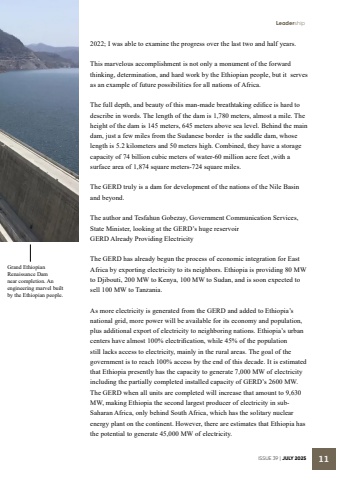
LeadershipISSUE 39 | JULY 2025 112022; I was able to examine the progress over the last two and half years.This marvelous accomplishment is not only a monument of the forward thinking, determination, and hard work by the Ethiopian people, but it serves as an example of future possibilities for all nations of Africa.The full depth, and beauty of this man-made breathtaking edifice is hard to describe in words. The length of the dam is 1,780 meters, almost a mile. The height of the dam is 145 meters, 645 meters above sea level. Behind the main dam, just a few miles from the Sudanese border is the saddle dam, whose length is 5.2 kilometers and 50 meters high. Combined, they have a storage capacity of 74 billion cubic meters of water-60 million acre feet ,with a surface area of 1,874 square meters-724 square miles.The GERD truly is a dam for development of the nations of the Nile Basin and beyond.The author and Tesfahun Gobezay, Government Communication Services, State Minister, looking at the GERD%u2019s huge reservoirGERD Already Providing ElectricityThe GERD has already begun the process of economic integration for East Africa by exporting electricity to its neighbors. Ethiopia is providing 80 MW to Djibouti, 200 MW to Kenya, 100 MW to Sudan, and is soon expected to sell 100 MW to Tanzania.As more electricity is generated from the GERD and added to Ethiopia%u2019s national grid, more power will be available for its economy and population, plus additional export of electricity to neighboring nations. Ethiopia%u2019s urban centers have almost 100% electrification, while 45% of the population still lacks access to electricity, mainly in the rural areas. The goal of the government is to reach 100% access by the end of this decade. It is estimated that Ethiopia presently has the capacity to generate 7,000 MW of electricity including the partially completed installed capacity of GERD%u2019s 2600 MW. The GERD when all units are completed will increase that amount to 9,630 MW, making Ethiopia the second largest producer of electricity in subSaharan Africa, only behind South Africa, which has the solitary nuclear energy plant on the continent. However, there are estimates that Ethiopia has the potential to generate 45,000 MW of electricity.Grand Ethiopian Renaissance Dam near completion. An engineering marvel built by the Ethiopian people.


