


Page 53 - Msingi Afrika Magazine Issue 34
P. 53
Art & Culture


               in my white vest and kikoi greeting a refreshing       at the door waiting to take me for

               breeze from the sea. The vest helped to regulate       breakfast at the sea of Lamu Island.
               my body temperature, and the kikoi kept my lower
               half cool. The sebule (bedroom) had a notable six-     The sunrise warmed the calm sea

               by-six bed made of carved mangrove wood with           causing sparkles of light to dance
               a rhythm of floral design. The bed had a specific      on the mashuas. Fishermen emerged
               name, pilipili, which is a Swahili word that means     from the sea carrying buckets of fish,
               green chili pepper. The bed has a top rear part of     while passengers were still sailing on
               the bed resembles how the chilies actually grow        mashuas. People jovially exchanged

               on a real tree. Far in the corner, there was a two-    cock crow Islamic greetings “As-
               by-four bed made of coconut leaves called ushutu.      salaam alaykum “ with one another.
               It was used by pregnant mothers and a woman

               nursing a baby. Opposite ushutu was bembeya (a         A small crowd of men enjoying cups
               swinging baby carrier) made of mangrove wood           of kahawa tungu, kahawa tamu, and
               wrapped with pieces of leso and kikoi.                 chai ya mwarabu. They hold pieces of
                                                                      viazi karai, mitai labania, kahimati,
               I reclined on the pili pili bed with my stomach        mahamuri, and keki ya wali (Swahili

               facing down, then turned right, rolled left and        breakfast). Bakari instructed the man
               eventually l was asleep, dreaming vividly.             serving breakfast, “yu mgeni wangu
               Abruptly, l heard a hard knock on the door and         mtafiti chuoni mpe chai kaka!” (he

               sprinted out of the pili pili bed. Mzee Bakari was     is my visitor and a scholar from the


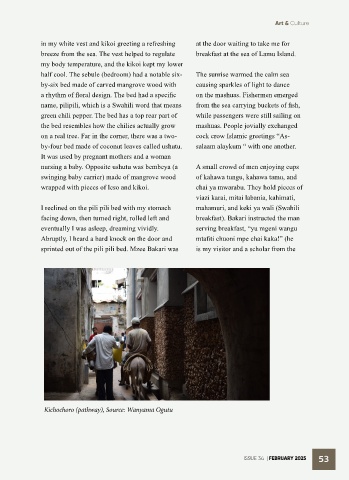
                Kichochoro (pathway), Source: Wanyama Ogutu


                                                                                      ISSUE 34  | FEBRUARY 2025  53

