


Page 55 - Msingi Afrika Magazine Issue 34
P. 55
Art & Culture


               is long. Satan took me through key historic

               places on Lamu Island. He furnished me
               with insightful information about the Swahili
               culture. He guided me through vichochoro

               (pathways) which were densely populated
               with old Swahili houses, Swahili galleries,
               old shops and vibanda (small shops), and the
               graveyard of the Sultans. We mingled with
               a group of young and old women dressed

               in colorful buibuis’ and hijabs. We greeted
               old and young men wearing white kanzus
               with Islamic caps, a pair of shorts, vikoi, and

               sports t-shirts. We stood aside to pave the
               way for donkeys carrying luggage. We edged
               against vichochoro walls to let a man riding
               a donkey pass on a swift. We spotted a pack
               of dogs with sympathetic eyes lying on the

               Bajuni’s doors. We saw a clowder of cats
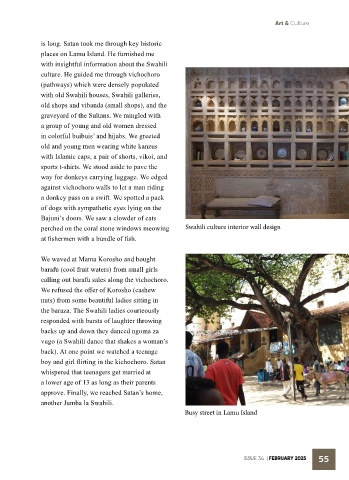
               perched on the coral stone windows meowing         Swahili culture interior wall design
               at fishermen with a bundle of fish.


               We waved at Mama Korosho and bought
               barafu (cool fruit waters) from small girls
               calling out barafu sales along the vichochoro.
               We refused the offer of Korosho (cashew

               nuts) from some beautiful ladies sitting in
               the baraza. The Swahili ladies courteously
               responded with bursts of laughter throwing

               backs up and down they danced ngoma za
               vugo (a Swahili dance that shakes a woman’s
               back). At one point we watched a teenage
               boy and girl flirting in the kichochoro. Satan
               whispered that teenagers get married at

               a lower age of 13 as long as their parents
               approve. Finally, we reached Satan’s home,
               another Jumba la Swahili.
                                                                  Busy street in Lamu Island


                                                                                      ISSUE 34  | FEBRUARY 2025  55

