


Page 36 - Demo
P. 36
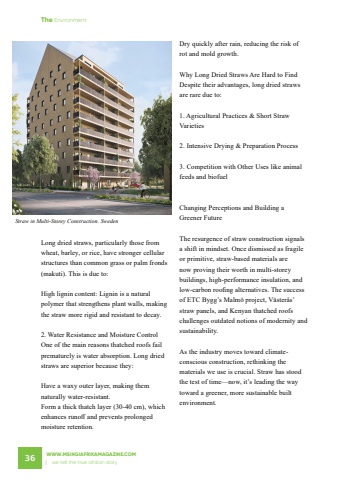
The EnvironmentWWW.MSINGIAFRIKAMAGAZINE.COM | we tell the true afrikan story 36Long dried straws, particularly those from wheat, barley, or rice, have stronger cellular structures than common grass or palm fronds (makuti). This is due to:High lignin content: Lignin is a natural polymer that strengthens plant walls, making the straw more rigid and resistant to decay.2. Water Resistance and Moisture ControlOne of the main reasons thatched roofs fail prematurely is water absorption. Long dried straws are superior because they:Have a waxy outer layer, making them naturally water-resistant.Form a thick thatch layer (30-40 cm), which enhances runoff and prevents prolonged moisture retention.Dry quickly after rain, reducing the risk of rot and mold growth.Why Long Dried Straws Are Hard to FindDespite their advantages, long dried straws are rare due to:1. Agricultural Practices & Short Straw Varieties2. Intensive Drying & Preparation Process3. Competition with Other Uses like animal feeds and biofuelChanging Perceptions and Building a Greener FutureThe resurgence of straw construction signals a shift in mindset. Once dismissed as fragile or primitive, straw-based materials are now proving their worth in multi-storey buildings, high-performance insulation, and low-carbon roofing alternatives. The success of ETC Bygg%u2019s Malm%u00f6 project, V%u00e4ster%u00e5s%u2019 straw panels, and Kenyan thatched roofs challenges outdated notions of modernity and sustainability.As the industry moves toward climateconscious construction, rethinking the materials we use is crucial. Straw has stood the test of time%u2014now, it%u2019s leading the way toward a greener, more sustainable built environment.Straw in Multi-Storey Construction. Sweden


