


Page 39 - Msingi Afrika Magazine Issue 34
P. 39
The Environment


               a) Sashimono (Japan):

               Sashimono involves                  Beyond steel, nails
               precisely crafted interlocking
               wooden joints, requiring            and glue: Traditional

               no adhesives or nails.
               Its legacy can be seen              woodworking
               in traditional Japanese
               furniture and architecture,         techniques inspiring
               where durability is achieved

               through tight-fitting joinery       Sustainable Building
               that resists wear over time.
                                                   Design

               b) Dovetail Joints (Global):

               This technique uses                  RONALD MBIU, NAIROBI, KENYA
               wedge-shaped interlocking
               fingers, commonly found
               in cabinetry and traditional     surfaces without visible fasteners. The technique also reduces

               timber framing. Dovetails        material waste and simplifies assembly.
               create mechanically strong
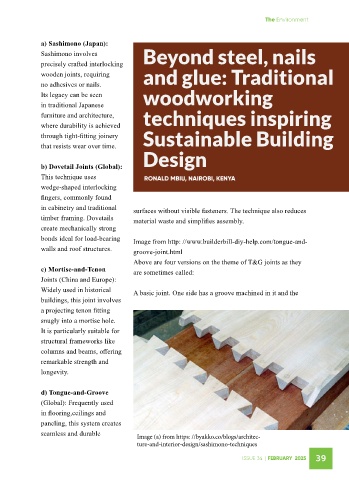
               bonds ideal for load-bearing     Image from http: //www.builderbill-diy-help.com/tongue-and-

               walls and roof structures.       groove-joint.html
                                                Above are four versions on the theme of T&G joints as they
               c) Mortise-and-Tenon             are sometimes called:
               Joints (China and Europe):
               Widely used in historical        A basic joint. One side has a groove machined in it and the

               buildings, this joint involves
               a projecting tenon fitting
               snugly into a mortise hole.

               It is particularly suitable for
               structural frameworks like
               columns and beams, offering
               remarkable strength and
               longevity.


               d) Tongue-and-Groove
               (Global): Frequently used

               in flooring,ceilings and
               paneling, this system creates
               seamless and durable              Image (a) from https: //byakko.co/blogs/architec-
                                                 ture-and-interior-design/sashimono-techniques


                                                                                      ISSUE 34  | FEBRUARY  2025  39

