


Page 40 - Msingi Afrika Magazine Issue 34
P. 40
The Environment


                                                                               elements in ceilings.


                                                                               Key Benefits
                                                                               1. Enhanced Durability for

                                                                               Architectural Structures
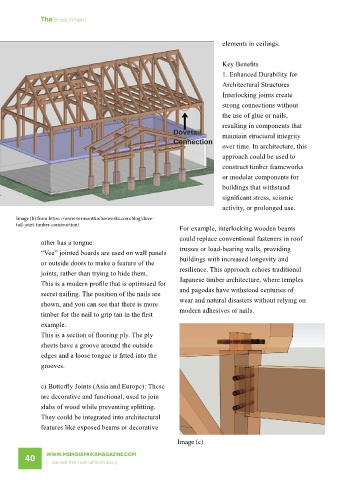
                                                                               Interlocking joints create
                                                                               strong connections without
                                                                               the use of glue or nails,
                                                                               resulting in components that

                                                                               maintain structural integrity
                                                                               over time. In architecture, this
                                                                               approach could be used to

                                                                               construct timber frameworks
                                                                               or modular components for
                                                                               buildings that withstand
                                                                               significant stress, seismic
                                                                               activity, or prolonged use.

       Image (b) from https: //www.vermonttimberworks.com/blog/dove-
       tail-joint-timber-construction/
                                                                For example, interlocking wooden beams
                                                                could replace conventional fasteners in roof
               other has a tongue.
               “Vee” jointed boards are used on wall panels     trusses or load-bearing walls, providing

               or outside doors to make a feature of the        buildings with increased longevity and
               joints, rather than trying to hide them.         resilience. This approach echoes traditional
               This is a modern profile that is optimised for   Japanese timber architecture, where temples
               secret nailing. The position of the nails are    and pagodas have withstood centuries of

               shown, and you can see that there is more        wear and natural disasters without relying on
               timber for the nail to grip tan in the first     modern adhesives or nails.
               example.
               This is a section of flooring ply. The ply

               sheets have a groove around the outside
               edges and a loose tongue is fitted into the
               grooves.


               e) Butterfly Joints (Asia and Europe): These
               are decorative and functional, used to join
               slabs of wood while preventing splitting.
               They could be integrated into architectural

               features like exposed beams or decorative

                                                               Image (c)

                 WWW.MSINGIAFRIKAMAGAZINE.COM
          40
                 |   we tell the true afrikan story

