


Page 43 - Msingi Afrika Magazine Issue 34
P. 43
The Environment


                                                                    emphasizing craftsmanship while

                                                                    maintaining structural integrity.
                                                                •  Seismic-Resistant Designs: Buildings
                                                                    in earthquake-prone regions can benefit

                                                                    from flexible, interlocking joints like
                                                                    those used in Hōryū-ji, where joinery
                                                                    absorbs and redistributes seismic forces,
                                                                    reducing damage.


                                                                A Sustainable Future Rooted in Tradition


                                                                Reviving woodworking techniques like

                                                                Sashimono, dovetails, and mortise-and-
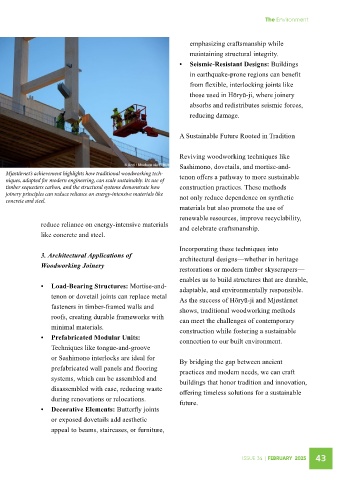
   Mjøstårnet’s achievement highlights how traditional woodworking tech-  tenon offers a pathway to more sustainable
   niques, adapted for modern engineering, can scale sustainably. Its use of
   timber sequesters carbon, and the structural systems demonstrate how   construction practices. These methods
   joinery principles can reduce reliance on energy-intensive materials like   not only reduce dependence on synthetic
   concrete and steel.
                                                                materials but also promote the use of

                                                                renewable resources, improve recyclability,
               reduce reliance on energy-intensive materials    and celebrate craftsmanship.
               like concrete and steel.


                                                                Incorporating these techniques into
               3. Architectural Applications of                 architectural designs—whether in heritage
               Woodworking Joinery                              restorations or modern timber skyscrapers—

                                                                enables us to build structures that are durable,
               •  Load-Bearing Structures: Mortise-and-         adaptable, and environmentally responsible.
                   tenon or dovetail joints can replace metal   As the success of Hōryū-ji and Mjøstårnet
                   fasteners in timber-framed walls and         shows, traditional woodworking methods
                   roofs, creating durable frameworks with      can meet the challenges of contemporary

                   minimal materials.                           construction while fostering a sustainable
               •  Prefabricated Modular Units:                  connection to our built environment.
                   Techniques like tongue-and-groove
                   or Sashimono interlocks are ideal for        By bridging the gap between ancient

                   prefabricated wall panels and flooring       practices and modern needs, we can craft
                   systems, which can be assembled and          buildings that honor tradition and innovation,
                   disassembled with ease, reducing waste       offering timeless solutions for a sustainable
                   during renovations or relocations.           future.

               •  Decorative Elements: Butterfly joints
                   or exposed dovetails add aesthetic
                   appeal to beams, staircases, or furniture,


                                                                                      ISSUE 34  | FEBRUARY  2025  43

