


Page 42 - Msingi Afrika Magazine Issue 34
P. 42
The Environment


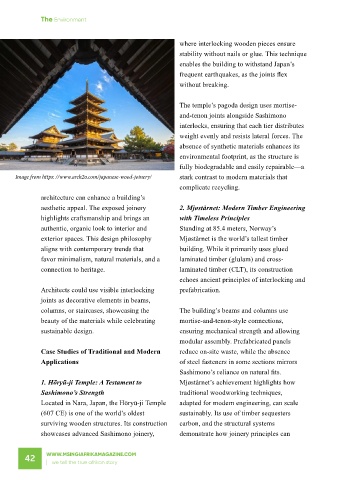
                                                                where interlocking wooden pieces ensure

                                                                stability without nails or glue. This technique
                                                                enables the building to withstand Japan’s
                                                                frequent earthquakes, as the joints flex

                                                                without breaking.


                                                                The temple’s pagoda design uses mortise-
                                                                and-tenon joints alongside Sashimono
                                                                interlocks, ensuring that each tier distributes

                                                                weight evenly and resists lateral forces. The
                                                                absence of synthetic materials enhances its
                                                                environmental footprint, as the structure is

                                                                fully biodegradable and easily repairable—a
      Image from https: //www.arch2o.com/japanese-wood-joinery/  stark contrast to modern materials that
                                                                complicate recycling.
               architecture can enhance a building’s
               aesthetic appeal. The exposed joinery            2. Mjøstårnet: Modern Timber Engineering

               highlights craftsmanship and brings an           with Timeless Principles
               authentic, organic look to interior and          Standing at 85.4 meters, Norway’s
               exterior spaces. This design philosophy          Mjøstårnet is the world’s tallest timber

               aligns with contemporary trends that             building. While it primarily uses glued
               favor minimalism, natural materials, and a       laminated timber (glulam) and cross-
               connection to heritage.                          laminated timber (CLT), its construction
                                                                echoes ancient principles of interlocking and
               Architects could use visible interlocking        prefabrication.

               joints as decorative elements in beams,
               columns, or staircases, showcasing the           The building’s beams and columns use
               beauty of the materials while celebrating        mortise-and-tenon-style connections,

               sustainable design.                              ensuring mechanical strength and allowing
                                                                modular assembly. Prefabricated panels
               Case Studies of Traditional and Modern           reduce on-site waste, while the absence
               Applications                                     of steel fasteners in some sections mirrors
                                                                Sashimono’s reliance on natural fits.

               1. Hōryū-ji Temple: A Testament to               Mjøstårnet’s achievement highlights how
               Sashimono’s Strength                             traditional woodworking techniques,
               Located in Nara, Japan, the Hōryū-ji Temple      adapted for modern engineering, can scale

               (607 CE) is one of the world’s oldest            sustainably. Its use of timber sequesters
               surviving wooden structures. Its construction    carbon, and the structural systems
               showcases advanced Sashimono joinery,            demonstrate how joinery principles can


                 WWW.MSINGIAFRIKAMAGAZINE.COM
          42
                 |   we tell the true afrikan story

