




Divine Lingo

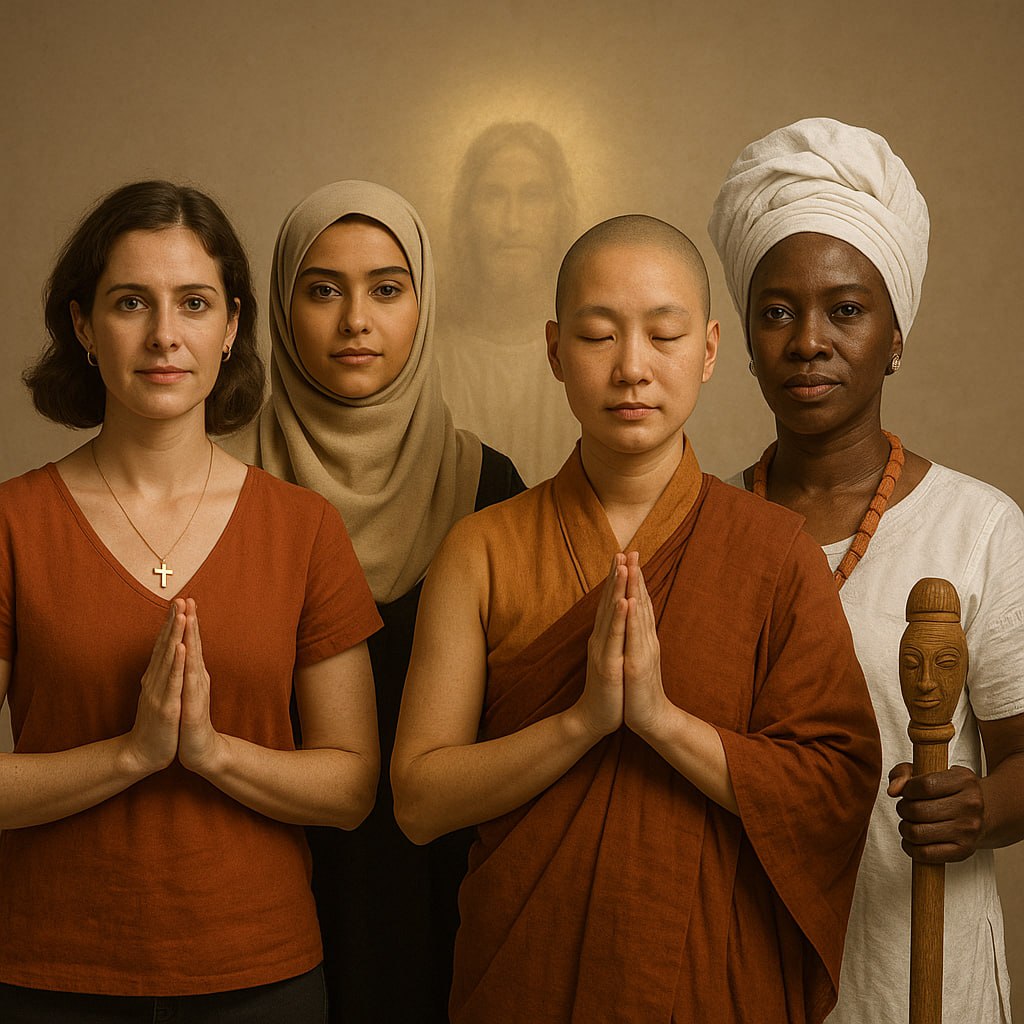

Breaking the Bonds of Sentiments: Faith Beyond
Religion, Beyond Language
We’ve made a prison out of faith.
Not a visible prison, but one built with sentiments, sectarian walls, and scriptural arrogance. What was meant to be a bridge to the Divine has become a battlefield of holy verses, a competitive shouting match of “whose God is truer.” We’ve mistaken echoes for enlightenment, and in doing so, turned sacred texts into weapons of mass division.
But that was never the way of the Christ.
Jesus — the Jewish rabbi, the son of David — stunned his own disciples when he praised the faith of a Roman centurion, saying, “Truly I tell you, I have not found anyone in Israel with such great faith” (Matthew 8:10). A few chapters later, he honors a Syrophoenician woman, culturally and religiously outside the covenant community, saying, “Woman, you have great faith! Your request is granted” (Matthew 15:28).
Jesus saw beyond religion.
He listened beyond creed.
He responded to substance, not symbolism.
And yet today, we do the opposite. We exalt dogma over depth, ritual over resonance, and we allow extremes of religion to define the divine.
Take, for instance, the Qur’an’s verse in Surah At-Tawbah (9:5): “Kill the polytheists wherever you find them…” Often misunderstood, this was revealed in a time of military conflict, with specific treaties broken. Context matters. Scholars like Karen Armstrong and Reza Aslan remind us that this was a wartime directive, not a universal command. Yet stripped of context, this verse — like many verses from the Bible and Torah — becomes a tool for hate instead of healing.
Christianity, too, isn’t immune to doctrinal distortion.
The words of Jesus — “I am the way, the truth, and the life” (John 14:6) — have often been used to assert religious superiority rather than spiritual invitation. Yet Jesus never created a religion. He revealed a pattern of existence — a way to be fully human and fully aligned with the Divine.
What if “I am the way…” actually meant:
- Live like I live.
- Love like I love.
- Die to ego like I do.
- See God in the lowly, not just the lofty.
Then “the way” becomes a universal lifestyle, not a denominational brand.
Because when you strip away your flag, your name, your book, and your label — what remains is the sincere cry of the heart. And that cry is spoken in four realms. If you only listen to one, you’ll mistake the light for the lampshade.
1. Linguistic (Mouth) Language
This is where we name the Divine: Jesus, Allah, Yahweh, Olodumare, IFA, Buddha. These are not rivals. They are cultural metaphors attempting to name the unnameable. The Divine doesn’t live in grammar.

2. Physical (Body) Language
Bowing in Islam. Kneeling in Christianity. Dancing in Yoruba worship. Stillness in Zen. The body becomes the scripture, writing reverence without words.
3. Emotive/Soul Language
Tears, awe, surrender. The thief on the cross had no ritual, no doctrine — but Jesus heard his soul and said, “Today you will be with me in Paradise.” Soul language always reaches further than ritual.
4. Spiritual (Spirit) Language
This is pre-verbal, beyond emotion — the place of vibration, frequency, divine attunement. Here, all names dissolve. All cultures bow. And Christ, Allah, Olodumare, the Buddha-nature, and the spirit of IFA harmonize into One Sound.


So why are we still divided?
Because extreme religion thrives on fear, not faith. It uses scriptures as swords, not as mirrors. It isolates the “other” to affirm the self.
But faith — true faith — is recognizing the Divine pattern in those outside your tribe. It’s what Jesus saw in the Roman soldier and Canaanite woman. It’s what Rumi called “the religion of love, beyond all beliefs.” It’s what the Ifá tradition speaks of as “ase” — the life force that binds all existence, regardless of label.
The Divine does not speak in just one tongue.
The Divine speaks in many, yet says the same thing:
‘Come home.’
Because here’s the ultimate truth:
If you cannot see your faith in others, you’re living in a mirage — and in the isolation of yourself alone.

But faith — true faith — is recognizing the Divine pattern in those outside your tribe. It’s what Jesus saw in the Roman soldier and Canaanite woman. It’s what Rumi called “the religion of love, beyond all beliefs.” It’s what the Ifá tradition speaks of as “ase” — the life force that binds all existence, regardless of label.
What's Your Reaction?